
658.88kW Microinverter PV Station, Tiantai, Zhejiang
Release Date:2026-02-20Source:Hangzhou Ginpon New Energy Co.,Ltd.
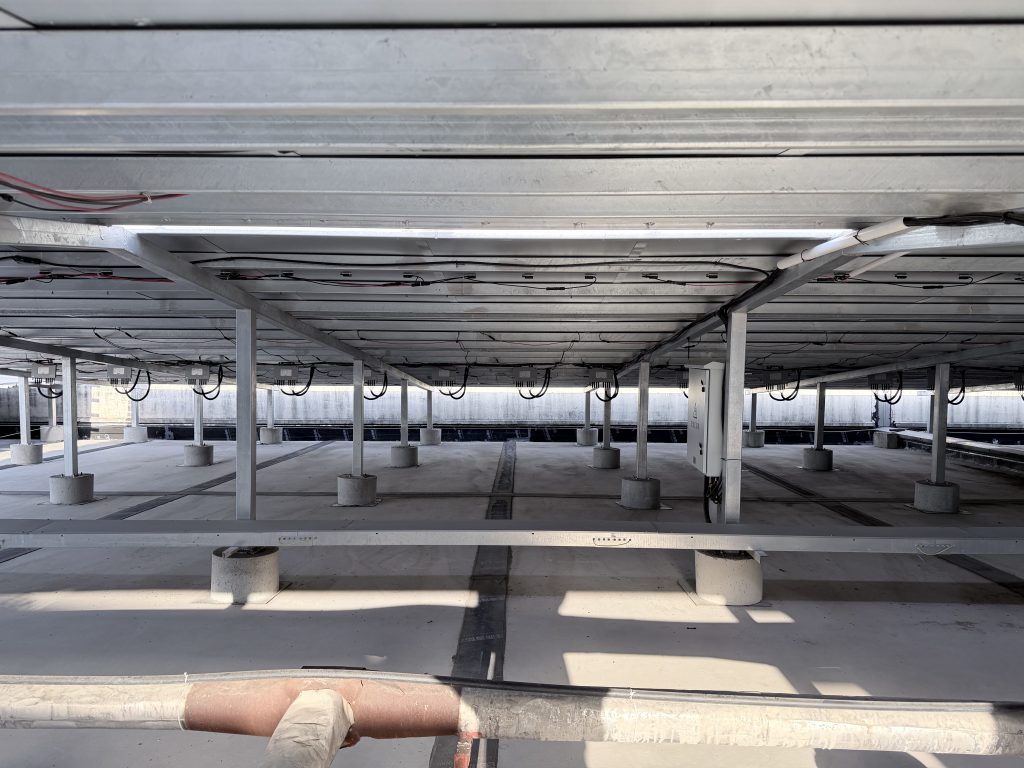
Project Background & Requirements
Tiantai County, a Zhejiang pilot for county-wide distributed PV, features mountainous terrain, complex roofs, and prevalent shading. The project owner, a local manufacturer, has a ~7,000㎡ multi-slope factory roof with shading, uneven load capacity, and strong EMI (VFDs/motors). Key requirements focus on four areas:
- Maximize roof space, boost generation and returns.
- Eliminates DC high-voltage risks, ensures plant safety, complies with fire codes.
- Anti-interference, low BER, stable communication — suitable for high-interference industrial environments.
- Module-level monitoring and simple O&M reduce long-term costs, aligning with Zhejiang's low-voltage multi-point access policy.
Traditional string solutions failed due to DC high voltage, shading mismatch, and unstable communication. The all-microinverter solution was chosen to completely resolve these industry pain points.
Core System Configuration (658.88 kWp)
PV Modules
Specs: 580Wp high-efficiency monocrystalline modules
Qty: 1,136 modules (1,136 × 580W ≈ 658.88 kWp)
Features: High power, low degradation, anti-PID, suitable for hot/humid coastal environments.
Microinverter (Core)
Model: Single-phase Microinverter (1-to-4)
Unit power: 2kW
Mounting & Installation
Type: Aluminum rails + waterproof clamps (for color steel tile/concrete roofs)
Tilt: 22°–28° (optimal for Tiantai)
Features: Non-penetrating, reliable waterproofing, lightweight — suitable for old roof load-bearing.
Grid Connection & Monitoring
Grid connection: 0.4kV low-voltage multi-point access (Zhejiang simplified process)
Monitoring: cloud platform + local touchscreen, module-level real-time data monitoring.
Protection: over/under-voltage, anti-islanding, leakage, lightning, high-temp derating — full coverage.
Key Technical Solution (Microinverter Advantages Realized)
Module-level MPPT: 12–18% higher generation
Independent MPPT per module; shading, dirt, or orientation differences don't affect others. +~120,000 kWh/year vs. string inverters.
Ultimate safety: low-voltage DC, no hidden risks.
Module DC voltage <120V (safe for humans), no high-voltage DC cables, no arcing risk, fire code compliant — safe for live maintenance in factories.
Ultra-strong anti-interference: zero communication failures
Microinverters use AC/power line communication, avoiding RS485 DC interference. In high-interference plants: BER <10⁻⁸, zero packet loss, CRC errors, or dropouts.
Fast Construction & Phased Deployment
Microinverters enable plug-and-play grid connection and zoned construction without disrupting factory production — cutting construction time by 30% and significantly reducing labor costs.
Generation and Revenue Estimation (Tiantai Area)
Annual Generation
First-year generation: ~798,000 kWh (~1,211 full-load hours)
25-year total generation: ~18.35 million kWh, avg. annual degradation <0.45%
Economic Benefits
Self-consumption ratio: 75% (aligned with daytime production peak)
Revenue per kWh: ~0.85 RMB (self-consumption), ~0.41 RMB (surplus to grid).
Annual revenue: ~625k RMB, static payback: ~5.8 years
Environmental Benefits
Annual CO₂ reduction: ~795 t, 25-year total: ~18,300 t.
Equivalent to planting:~430,000 trees,supporting dual-carbon goals.
Project Value & Industry Significance
- Safety benchmark: First 600kW+ all-microinverter C&I plant in Tiantai, Zhejiang — zero DC high voltage, passed high-standard fire and safety inspections.
- Generation benchmark: On complex shaded roofs, generates 12–18% more than string inverters — validating microinverters' absolute advantage in hilly, multi-slope, and high-shading scenarios.
- Reliability benchmark: In high-interference plants, BER <10⁻⁸ — solving unstable communication & data loss in industrial PV.
- Policy alignment: Complies with Zhejiang's county-wide rollout, low-voltage connection, and unlimited self-consumption policies — setting a model for scaling C&I microinverters in Tiantai and eastern Zhejiang.